
Last Updated: March, 2026
Key Takeaways:
- Indiana joins a growing list of states restricting sweepstakes casinos, including Montana, Connecticut, New Jersey, New York, and California, as part of a wave of bans that began in 2025.
- If you still have Sweeps Coins to redeem, it’s best to act now. You should also avoid buying optional coin bundles, as platforms may leave the state before you reach the redemption threshold.
- Indiana players will still have access to legal alternatives such as poker, sports betting, and daily fantasy sports (DFS). Platforms like Global Poker, ClubWPT Gold, and Clubs Poker remain unaffected and can continue operating.
What Is Indiana HB 1052?
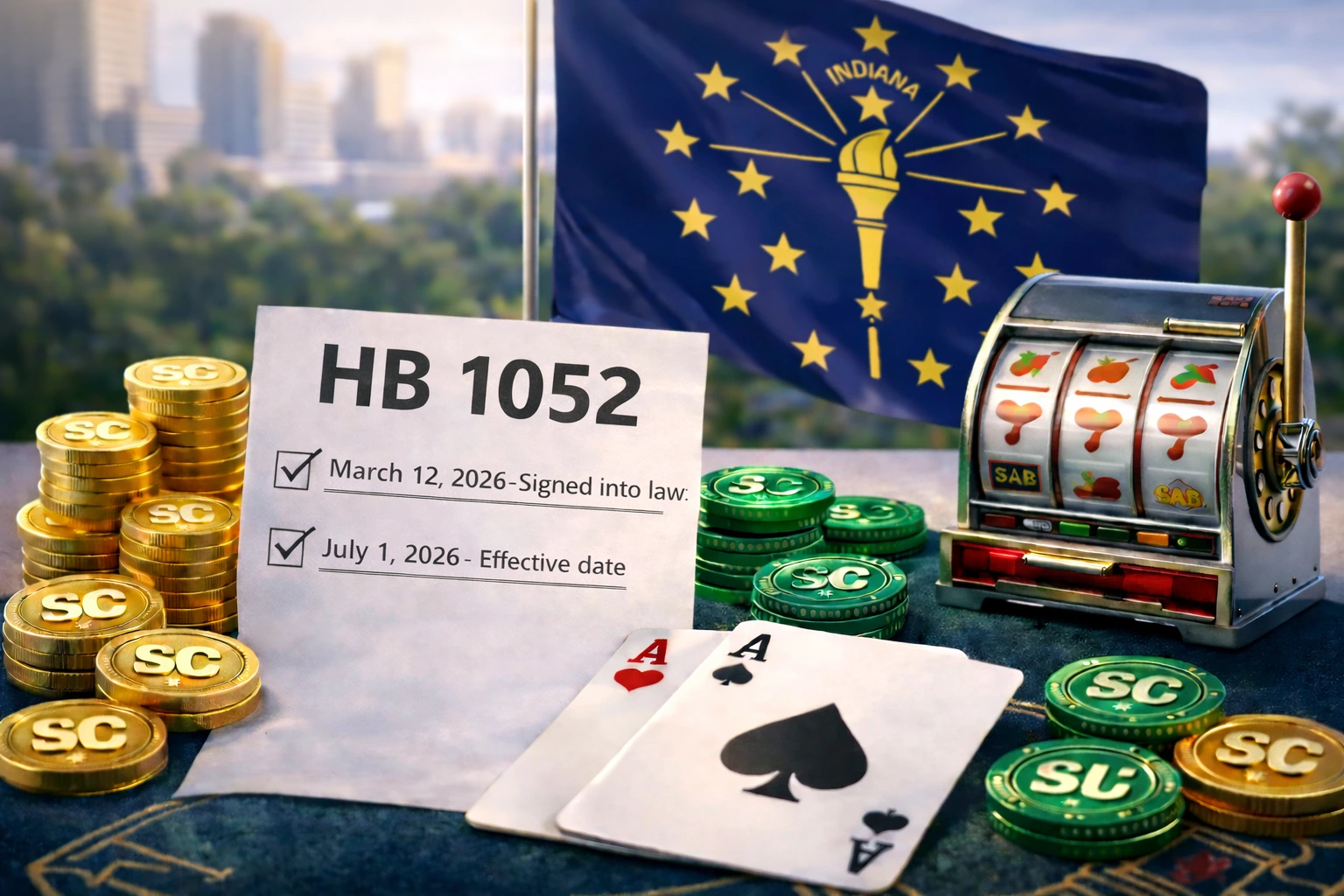
Simply put, Indiana House Bill 1052 is a law that prohibits sweepstakes casino platforms built on dual-currency systems , after Governor Mike Braun signed it into law on March 12, 2026. The idea behind the law is straightforward: if a platform lets you play with one currency for entertainment and redeem prizes with another, it can no longer operate under this model starting July 1, 2026, when enforcement begins.
This didn’t happen overnight, so here’s a quick look at how things developed:
| Date | Milestone | What Happened |
|---|---|---|
| December 5, 2025 | Bill filed | Lawmakers introduced the measure, raising concerns about the rapid growth of sweepstakes-style casino platforms operating in a legal gray area |
| January 20, 2026 | Committee approval | The House Public Policy Committee advanced the bill with a unanimous 10–0 vote |
| February 2, 2026 | House passage | The full House passed the bill 87–11, showing strong support and sending it to the Senate |
| February 17, 2026 | Senate passage | The Senate followed with a 37–8 vote, keeping the process moving quickly |
| February 26, 2026 | Final approvals | Both chambers approved the final version of the bill (Senate 46–4, House 68–21) |
| March 5, 2026 | Sent to governor | The bill reached the governor’s desk for final review |
| March 12, 2026 | Signed into law | Governor Mike Braun signed HB 1052 into law |
| July 1, 2026 | Effective date | Enforcement begins, giving operators and players a short window to adjust |
What Does HB 1052 Ban Exactly?
This might not be great news for some players, but there are no legal gray areas with this bill. Under Indiana HB 1052, a “sweepstakes game” is clearly defined as any game, contest, or promotion that meets these specific criteria:
- It is available online and accessible through devices like a mobile phone, computer, or similar platform
- It uses a dual-currency or multi-currency system that allows players to exchange virtual currency for cash prizes, cash equivalents, or even just the chance to win them
- It simulates traditional gaming formats such as lottery games or casino-style play, including slots, video poker, table games, bingo, or even sports betting
What really matters here is how this works in practice. Players typically use one type of virtual currency (Gold Coins) for play, while another (Sweeps Coins) can be redeemed for prizes like cash or gift cards. That redemption feature is exactly what the law targets.
Before HB 1052, operators relied on this setup to argue they were running promotional sweepstakes. That argument no longer holds, as the new definition closes the gap regulators previously struggled with and gives authorities clear grounds to act.
What Are the Penalties for Violations?
This is where things get serious, especially if you’re wondering whether platforms might try to keep operating after July 1, 2026.
Under HB 1052, here’s what operators are up against:
- Up to $100,000 per violation: Any operator knowingly offering sweepstakes games to Indiana players can face significant civil fines
- Each transaction can count separately: Penalties can add up quickly, not just per platform but per user activity
- Direct enforcement: The Indiana Gaming Commission has clear authority to pursue these fines against operators
It’s also important to understand how the law draws the line:
- Civil, not criminal penalties: Unlike in states like Montana, Connecticut, or New Jersey, penalties are financial — but still serious enough to shut platforms down
- Operators are the main target: The focus is on those running the platforms, rather than explicitly including payment processors or affiliates
Which Sweepstakes Casinos Are Affected in Indiana?
The short answer: almost all of them. If you’ve played at sweepstakes casinos in Indiana, chances are they fall directly under HB 1052. Most major platforms operate on the same dual-currency model that the law now prohibits.
Here’s how that breaks down:
- Major platforms affected: Operators tied to the Social Gaming Leadership Alliance include well-known brands like Chumba, LuckyLand Slots, Pulsz, Modo Casino, McLuck, and Hello Millions
- Other big names: Platforms like Stake.us and WOW Vegas also fall into the same category, using similar dual-currency systems
So what’s happening right now?
- No fixed exit dates yet: Most platforms haven’t officially announced when they’ll leave Indiana
- But the direction is clear: As the July 1, 2026, deadline approaches, more operators are expected to withdraw rather than risk enforcement
Industry groups like the Social Gaming Leadership Alliance have signaled interest in future regulatory discussions, but that’s a longer-term conversation.
Are Sweepstakes Poker Sites Still Legal in Indiana?
Yes, sweepstakes poker sites remain legal in Indiana under HB 1052. The law explicitly states that a banned sweepstakes game does not include peer-to-peer, skill-based poker games, creating a clear exemption for poker platforms.
That distinction makes a big difference for poker players. It’s also something we don’t usually see in sweepstakes regulation, as most states haven’t included such a clear poker carve-out.
This means you still have access to platforms like:
- Global Poker — one of the longest-running sweepstakes poker sites in the US, known for active cash games and regular tournaments
- ClubWPT Gold — backed by the World Poker Tour, offering a strong daily tournament schedule and built-in training features
- Clubs Poker — a newer option available across most US states, with a wide range of ring game formats
Why Did Indiana Ban Sweepstakes Casinos?
Indiana banned sweepstakes casinos because they operated in a legal gray area without clear regulation. State officials acknowledged that these platforms weren’t breaking existing laws, but that was the problem — there were no clear rules to enforce. HB 1052 was introduced to close that gap and bring them under a defined regulatory framework.
But the regulatory gap was only part of the story. Lawmakers had a broader set of concerns that shaped the final bill:
- No licensing requirements: Sweepstakes operators were offering casino-style products to hundreds of thousands of Indiana players without holding a state-issued license or going through any approval process
- No taxation: The Social Gaming Leadership Alliance (SGLA) itself argued that regulation could generate tens of millions in annual tax revenue, highlighting how much money was flowing outside the state’s tax system
- No responsible gaming obligations: Unlike licensed operators, these platforms weren’t required to implement age verification, responsible gaming tools, or data protection standards
In the end, it came down to this: players were accessing a gaming-like experience without the protections that usually come with it, and that’s what pushed lawmakers to act.
Could Some Lawmakers Have Supported Regulation Instead?
Yes. Some lawmakers pushed for regulating sweepstakes casinos instead of banning them. Proposals to introduce licensing, taxation, and player protections were seriously considered, but ultimately, most chose a full prohibition.
It was closer than the final outcome suggests.
Rep. Steve Bartels led the push for regulation, proposing a framework that included:
- $100,000 five-year license fee
- Mandatory annual audits
- Age verification requirements
- Player protection tools, such as spending limits
- Oversight by the Attorney General’s office
His argument was simple: the question wasn’t whether action was needed, but whether Indiana should try regulation before banning the model entirely. The proposal made it to a House vote but failed 54–34.
In the Senate, Ron Alting explored a similar approach, but the effort was withdrawn after facing strong resistance. Even among supporters of the ban, there was some hesitation. David Niezgodski voted in favor while noting he would have preferred regulation, leaving the door open for future discussions.
A full ban wasn’t the only option on the table. Lawmakers seriously considered regulation, but ultimately chose to shut the model down instead.
Which Other States Have Banned Sweepstakes Casinos?
Indiana's ban is part of a broader wave of states moving against sweepstakes casinos, a trend that began in 2025 and hasn’t slowed since. Several major states have already passed laws targeting the same dual-currency model.
Let’s take a closer look at how Indiana compares to other states:
| State | Law | Effective Date | Penalty Type |
|---|---|---|---|
| Montana | SB 555 | October 1, 2025 | Criminal |
| Connecticut | SB 1235 | October 1, 2025 | Criminal (up to 5 years) |
| New Jersey | A5447 | August 2025 | Criminal |
| New York | S5935A | December 2025 | Criminal |
| California | AB 831 | January 1, 2026 | Broad (includes affiliates) |
| Indiana | HB 1052 | July 1, 2026 | Civil only ($100K per violation) |
What stands out right away is how different Indiana’s approach is. While most states opted for criminal penalties, Indiana chose a civil enforcement model. It’s still strict, but structured differently.
And legislation is only part of the story.
- Cease-and-desist letters
- Regulatory pressure
- Targeted enforcement actions
States like Illinois, Louisiana, Tennessee, and Maryland have relied on these tools to push operators out without passing full legislation.
The map of legal sweepstakes casino states is shrinking fast, and Indiana is just following a broader nationwide shift that’s steadily closing the door on these platforms.
What Are Indiana Players' Options After July 1, 2026?
After July 1, 2026, Indiana players won’t be able to use sweepstakes casinos, but several legal alternatives remain available. These include licensed sports betting apps, daily fantasy sports, sweepstakes poker platforms, and the state lottery.
Here’s what’s still on the table:
- Sports betting: Indiana has had a legal online sports betting market since 2019, with over a dozen licensed operators, including DraftKings, FanDuel, BetMGM, Caesars, and BetRivers
- Daily Fantasy Sports (DFS): Fully legal since 2016, with platforms like DraftKings and FanDuel available. One key difference is that the minimum age is 18, not 21
- Sweepstakes poker: Platforms like Global Poker, ClubWPT Gold, and Clubs Poker remain legal under HB 1052’s poker exemption
- Hoosier Lottery: Offers draw games, scratch-offs, and some online options. It’s not a direct replacement, but it’s a regulated alternative
Indiana has 11 land-based casinos offering slots, table games, and poker, all fully licensed and regulated.
What Should Indiana Players Do Right Now?
If you’re currently playing on sweepstakes platforms, here’s the key thing to know: you still have time, but not much. It’s better to get ahead of the changes rather than wait for platforms to act.
Here’s what you can do right now:
- Redeem your balances early: Don’t wait until the last minute. Redeem your Sweeps Coins while platforms are still operating normally
- Check platform communications: Keep an eye on emails, account notifications, and site updates. Operators should announce timelines, restrictions, or shutdown steps in advance
- Understand the timeline: July 1, 2026, is the enforcement date, but some platforms may exit earlier. If a site you use suddenly restricts access, it’s likely tied to this rollout
Indiana Sweepstakes Casino Ban: FAQ
Are sweepstakes casinos still legal in Indiana?
Sweepstakes casinos are still technically accessible in Indiana, but that will change soon. Governor Mike Braun signed HB 1052 on March 12, 2026, and it takes effect on July 1, 2026, after which dual- and multi-currency casino-style platforms will be officially prohibited statewide.
What is the penalty for operating a sweepstakes casino in Indiana after July 1?
Operators can face civil penalties of up to $100,000 per violation in Indiana under HB 1052. Each transaction may count separately, so fines can add up quickly. While it’s not a criminal offense, the financial risk is significant enough to force platforms to exit the state.
Does the Indiana ban apply to sweepstakes poker?
No. HB 1052 explicitly excludes peer-to-peer, skill-based poker games, meaning sweepstakes poker is not covered by the ban. Platforms like Global Poker, ClubWPT Gold, and Clubs Poker are expected to continue operating in Indiana under this carve-out.
Will I get in trouble for playing sweepstakes casinos after the ban?
HB 1052 is aimed at operators, not individual players. The law’s civil penalties apply to those who knowingly run sweepstakes games online, meaning platforms and their operators, not users.
Which sweepstakes casinos will leave Indiana?
Most major sweepstakes casinos are expected to leave Indiana. Platforms that rely on dual-currency systems, including Chumba, Stake.us, Pulsz, McLuck, Hello Millions, and WOW Vegas, are likely to restrict access for Indiana players by July 1, 2026.
What alternatives do Indiana players have after July 2026?
Indiana players still have several legal options after July 2026. These include licensed online sports betting, land-based casinos, the state lottery, daily fantasy sports, and sweepstakes poker platforms, which remain available under the law’s poker exemption.
Who sponsored the Indiana sweepstakes casino ban?
HB 1052 was authored by Ethan Manning and sponsored in the Senate by Ron Alting. It passed with strong bipartisan support, clearing the House 87–11 and the Senate 37–8.
18+ Only. Void where prohibited. Sweepstakes casinos operate under promotional sweepstakes models and are intended for entertainment purposes only. No purchase is necessary to participate or claim prizes. Sweepedia.com is an independent review platform and holds no ownership interest in any sweepstakes casino operator. Please play responsibly. For more on healthy play habits, visit our responsible gameplay guide.
Comments
Log in to leave a comment
No comments yet. Be the first to share your thoughts!